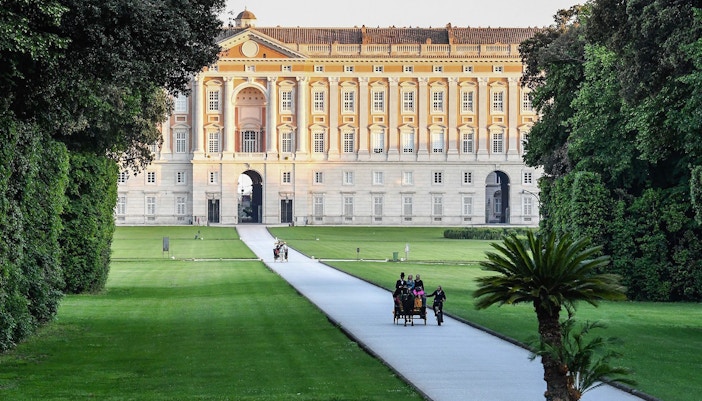
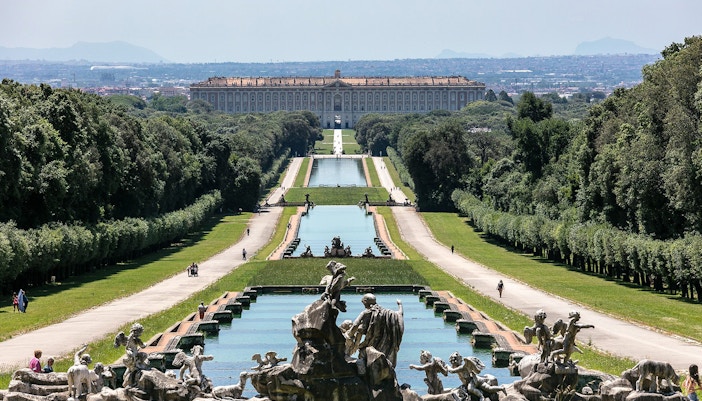
- Dimensions: The palace has a rectangular plan, measuring 247 × 184 meters.
- Courtyards: Four inner courts are formed by two orthogonal arms connecting the four sides.
- Floors: There are five floors in total.
- Rooms and windows: The palace boasts 1,200 rooms, including two dozen state apartments, 1,742 windows, 34 staircases, and 1,026 fireplaces. The palace has more than 40 monumental rooms completely decorated with frescoes, surpassing Versailles, which has only 22.
- Volume: It is the largest royal palace resulting from a single original project in the world in terms of volume, with more than 2 million cubic meters (70 million cubic feet).
- Floor space: The total floor space is 138,000 square meters.
Your guide to luxurious interiors of Royal Palace of Caserta
The grand facade of the Royal Palace of Caserta is just a teaser of the sheer luxury that awaits inside. As you climb the Grand Staircase, walk into the richly decorated Royal Apartments, and wander through the majestic courtyards, the opulence will engulf you! This guide helps you navigate the full monumentality of the Bourbon kings' residence.
Understanding the layout of Royal Palace of Caserta
The Royal Palace of Caserta is massive! We're talking five floors, 1,200 rooms (that's more than some small towns!), and enough windows to light up the whole of Naples (almost!). It’s a monumental example of Baroque architecture, designed to showcase the grandeur and power of the Bourbon monarchy. Let's take a closer look at the impressive layout of this vast palace.
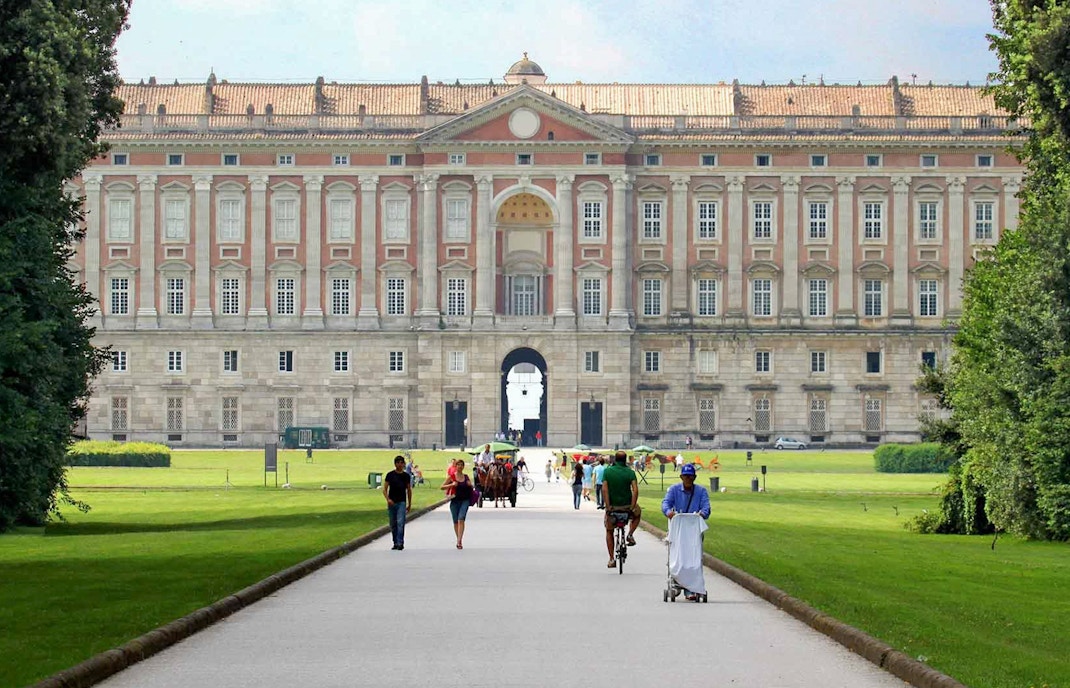
General layout
Floor plan
- The palace has a rectangular layout measuring 247 × 184 meters, with two orthogonal wings forming four inner courtyards. The main entrance leads to the grand staircase, state apartments including Throne Room and anterooms, and courtyards.
- The "Noble Floor," the main residential level, was originally divided into four areas, but only the lower right area was inhabited by the Bourbon royals.
- The upper floors of the palace have private rooms of the royal family and the stellar Palatine Library.
- Like many old castles, the Royal Palace of Caserta has a basement used for kitchens, workshops, storerooms, and servant quarters.
- Like Versailles, a large aqueduct was built to supply water for the palace’s extensive water displays.
Architectural style of the Royal Palace of Caserta's interiors
The architectural style of the Royal Palace of Caserta's interiors is primarily Baroque and Rococo, with neoclassical elements. The palace was designed by Luigi Vanvitelli, who was influenced by the Baroque and Rococo styles of the time. The palace's interior features intricate plasterwork, gilded details, and ornate decorations, which are characteristic of these styles.
Exploring the interiors of Royal Palace of Caserta
The Grand Staircase
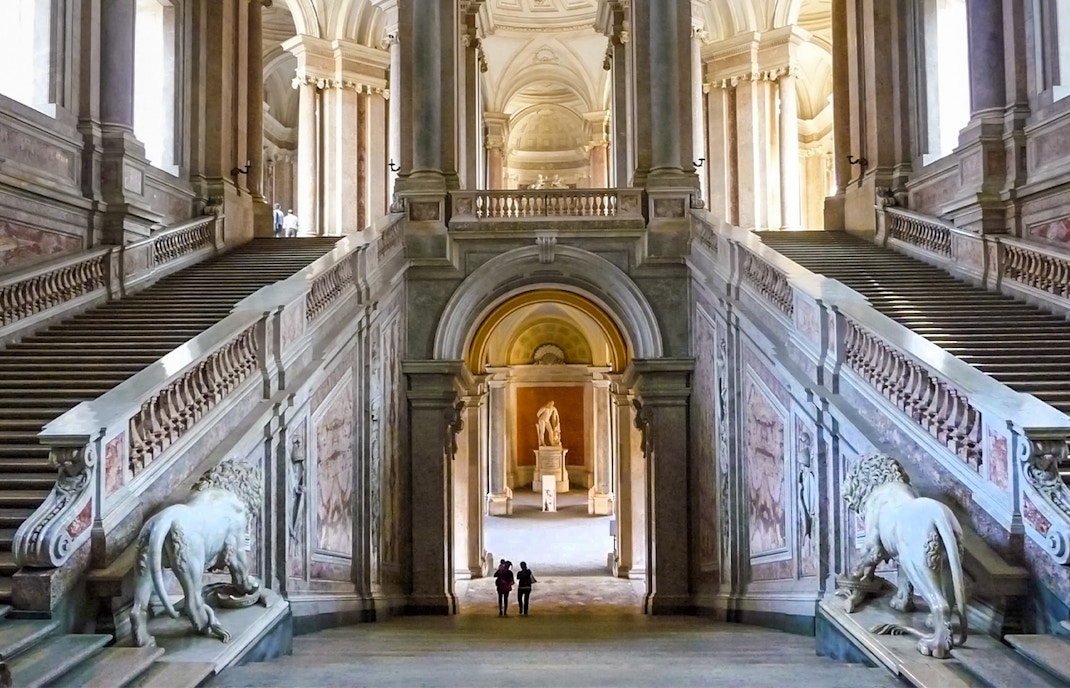
- This grand staircase, known as the Staircase of Honor, serves as the ceremonial entrance to the Royal Apartments, creating a dramatic first impression with sunlight highlighting the intricate marble work and statues.
- During the Bourbon era, a hidden orchestra pit nestled between the staircase's double vault would play unseen, adding a touch of grandeur to royal processions.
- Majestic lions flank the landing, symbolizing power, and a grand wall with statues of Merit, Majesty, and Truth, before expanding into two spectacular flights, culminating in an arched temple-like structure.
- A massive dome crowns the palace – an illusion of grandeur! Ascending further, you'll see a grand vestibule, reminiscent of a temple, leading to the Royal Apartments and Chapel.
The Royal Apartments
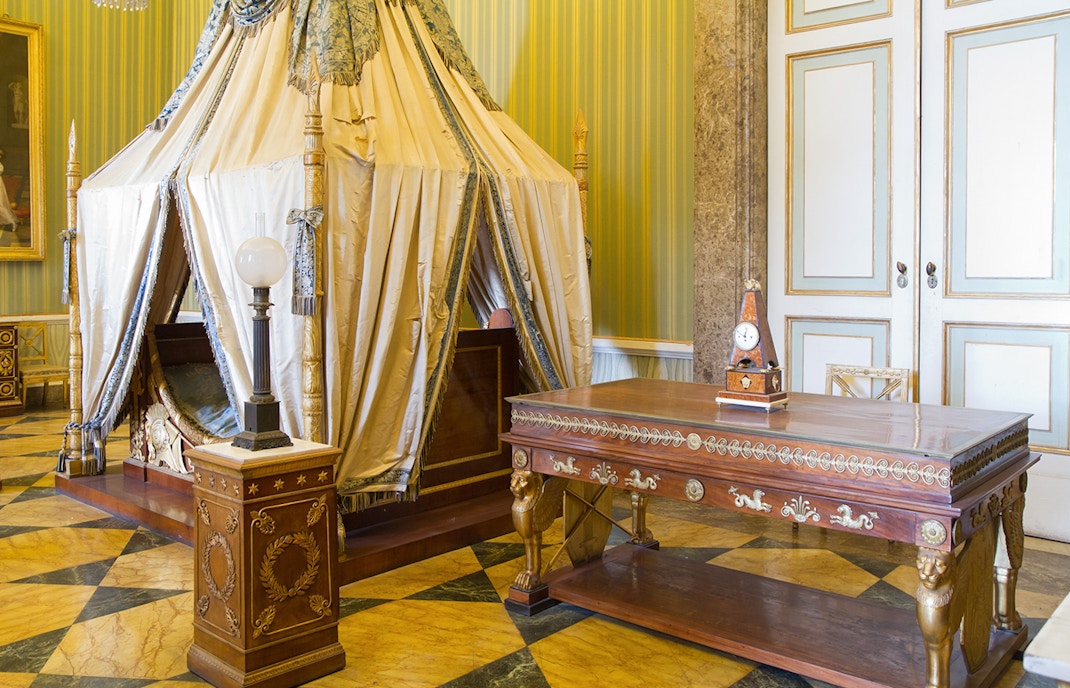
- The Royal Floor is one of the palace's five floors. This "Noble Floor" housed the private apartments of the Royal Family.
- The Queen's Apartment mirrors the King's, while the right side houses the Princes and Princesses.
- The Palatine Chapel and Theatre are the only rooms fully built by Luigi Vanvitelli. Despite funding cuts, Carlo Vanvitelli continued the work, completing the decoration by 1787. The lavish interiors of the Royal Apartments reflect the evolving tastes of the Bourbon monarchy.
The State Apartments
- The State Apartments are a series of interconnected rooms used for official functions. Begin with the Anterooms of the Halberdiers and Bodyguards, adorned with 19th-century chandeliers and terracotta floors.
- The Salon of Alexander, also known as the "Marble Hall," features a fresco by Mariano Rossi. The New Apartment, including the Throne Room with its neoclassical motifs, contrasts with the Old Apartment, introduced by the Anterooms of Mars and Astrea.
- Highlights also include the grand Throne Room, the Council Room, and the seasonal audience halls: Hall of Spring and Hall of Summer.
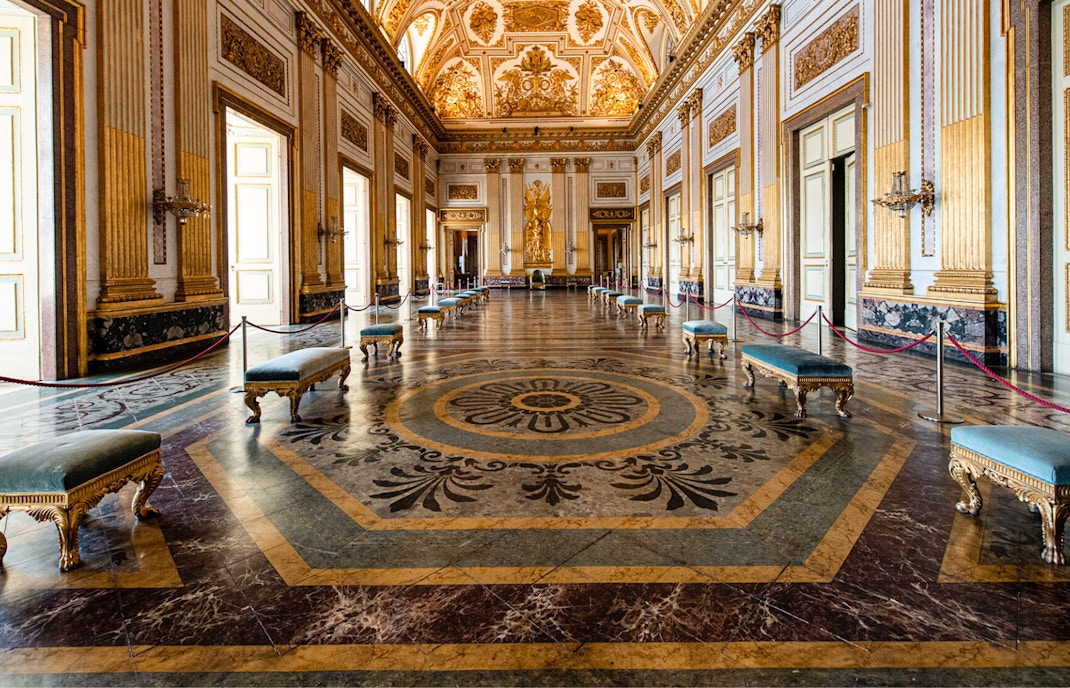
The King’s Private Chambers
- The 18th-century wing was the home to the Bourbon kings. These elegant Rococo halls exhibit sumptuous silk wallpaper from San Leucio, sparkling Murano glass chandeliers, and masterpieces by 19th-century artists.
- The tour starts with the Seasons' Rooms, featuring frescoes of the four seasons by Fedele Fischetti and Antonio de Dominicis. From here, delve deeper into the private world of the kings.
- Explore King Ferdinand's renowned study, which was once famed throughout Europe. Peek into the opulent bedroom of King Ferdinand II and Maria Theresa, tragically rebuilt after a fire.
- History buffs will appreciate King Joachim Murat's apartment, presenting original pieces from the Royal Palace of Portici.
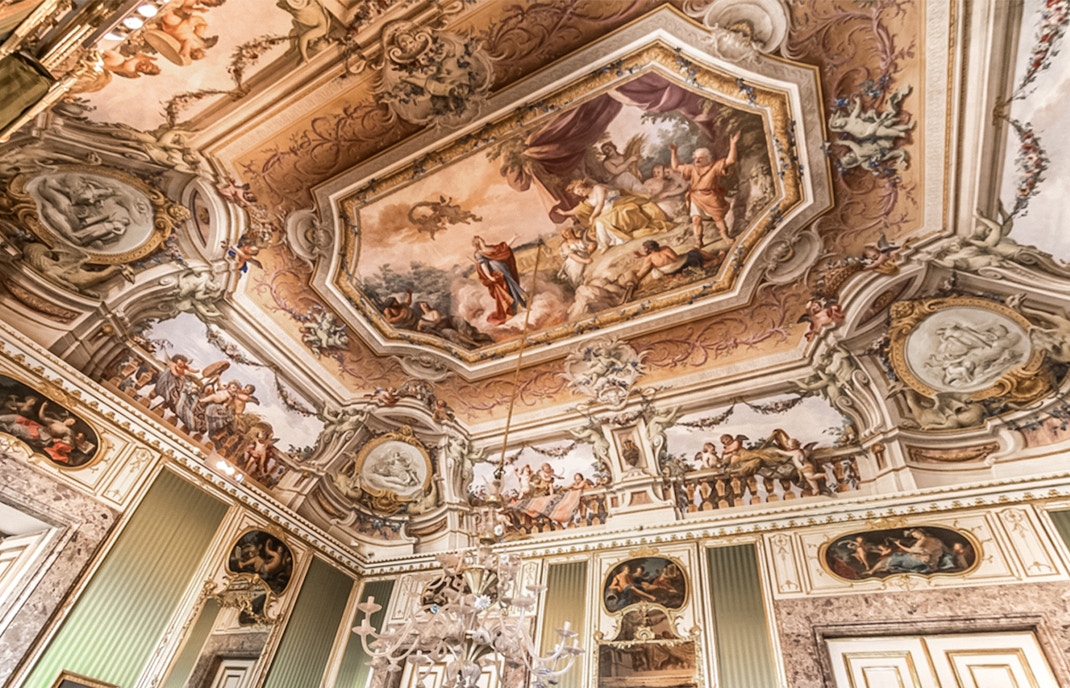
The Queen’s Private Chambers
- Queen Maria Carolina's apartment offers a delightful contrast to the King's more formal quarters. Here, the "rocaille" style reigns supreme, with its playful curves and delicate flourishes.
- Be sure to admire the three halls of the Palatine Library, noted for their neoclassical style and Pompeian decorations.
- The Elliptic Room, originally a home theatre, was known for its unique acoustics and now houses a Bourbonic-style Nativity scene.
- Additional highlights include the Queen's Bathroom, Boudoir, various library rooms, and the Audience Hall known as the "Golden Age Hall," along with multiple reading and living rooms.
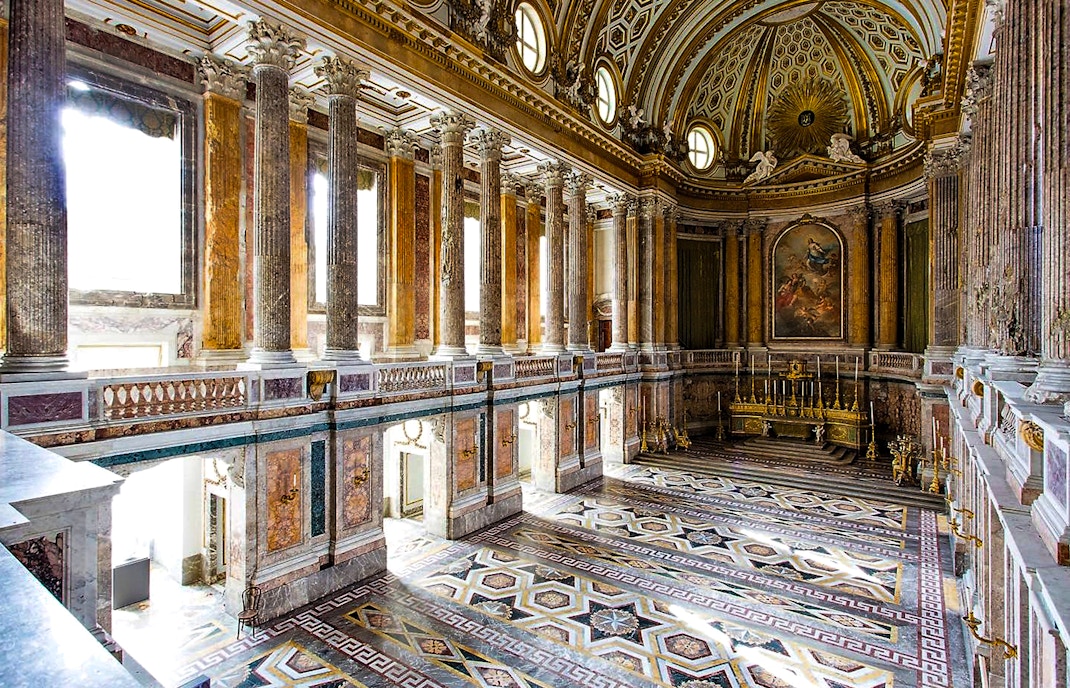
The Palatine Chapel
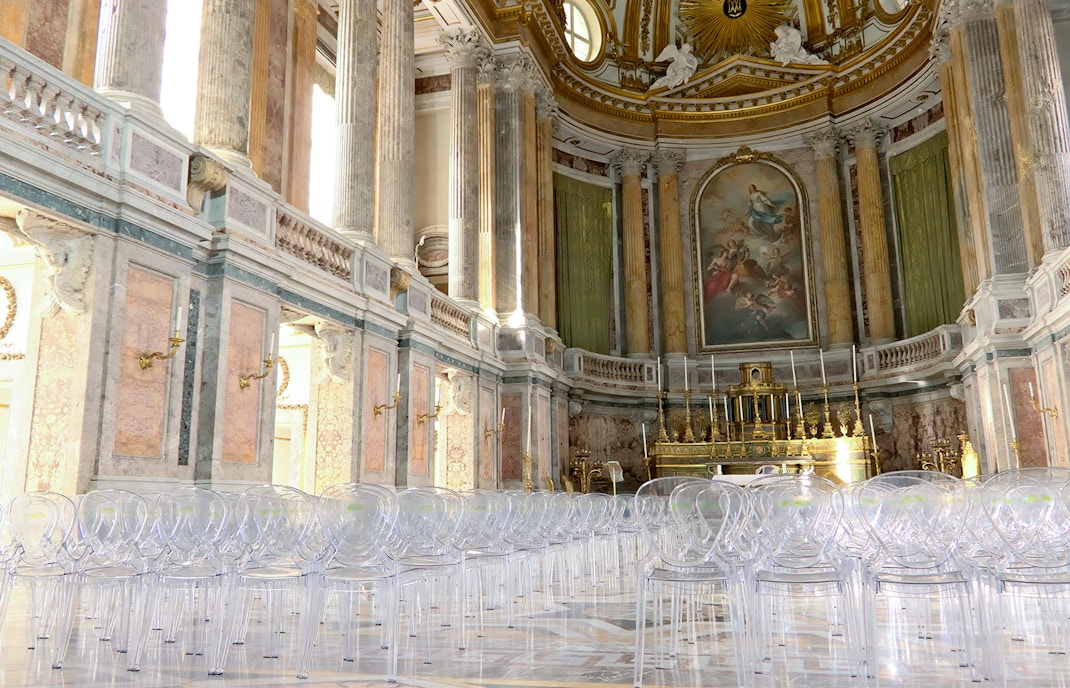
- Designed by Luigi Vanvitelli and inaugurated in 1784, the Palatine Chapel of Caserta blends Renaissance, Mannerist, and Baroque styles into a masterpiece of Neoclassical architecture, surpassing its original inspiration, Versailles.
- Built with no expense spared, the chapel features the finest marbles and craftsmanship of the Kingdom of Naples. Despite damage from World War II bombings, the chapel retains its grand dimension—a 39-meter-long nave flanked by sacristy passages and a hidden balcony above. It was Vanvitelli’s trick to maximize light filtering through high oval windows.
- While the original grand altar in precious stones was never completed, the current design – an ode to chapel's enduring commitment to artistic excellence in face of adversity – is worth seeing. Don't miss the Royal Tribune with its exquisite marble mosaics and Giuseppe Bonito's "Immaculate Conception".
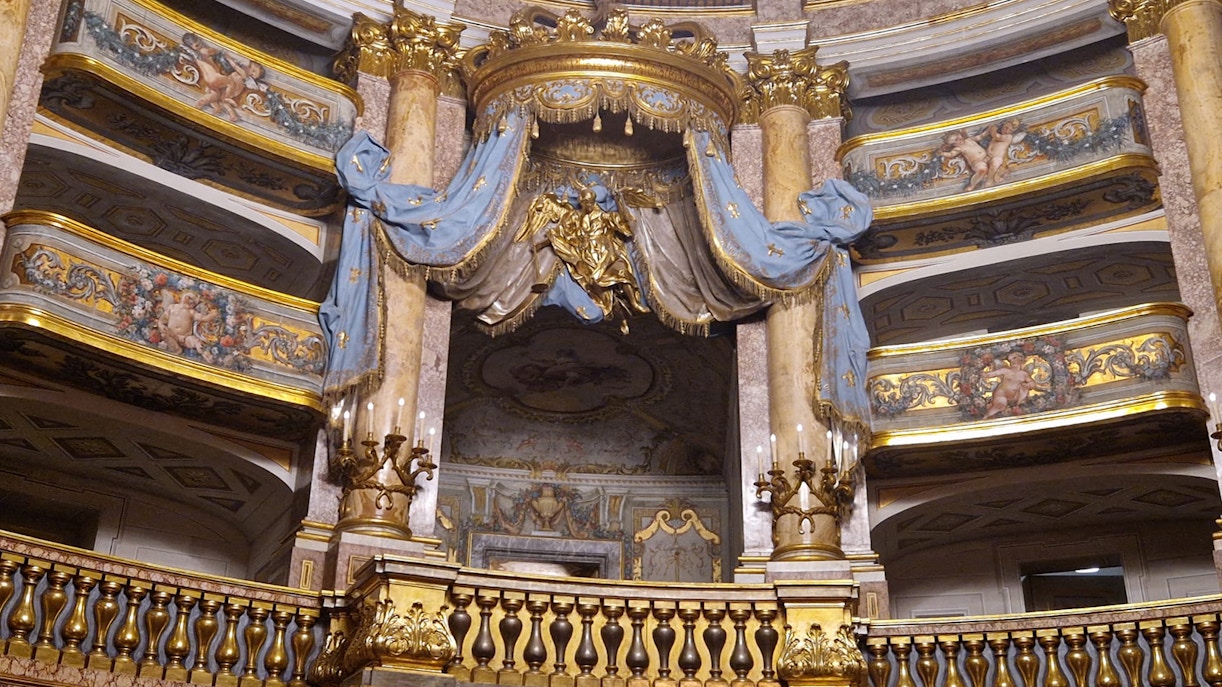
The Court Theatre
- Inspired by Naples' famous San Carlo, this mini version boasts a pioneering horseshoe shape with 41 boxes across five tiers and a grand Royal Box embellished with a majestic crown and Bourbon motifs.
- Decorated by Gaetano Magri, the Court Theatre's balconies feature intricate plasterwork and gilded details. It is crowned by Crescenzo La Gamba's frescoed ceiling of Apollo and the nine muses, complemented by the Royal Park backdrop.
- Unlike its grand cousin, the Court Theatre offers a more intimate experience. Originally built for private royal performances, it became a cultural hub, hosting a variety of events from dances to dramas until 1798.
Frequently asked questions about the Royal Palace of Caserta
Photography is allowed inside the Royal Palace of Caserta but with some restrictions. Flash photography and tripods for the purpose of commercial media and production are prohibited.
The Royal Palace of Caserta is huge! It has over 1,200 rooms, of which only 300 are accessible for public exploration. Apart from these, areas undergoing restoration work, such as the Royal Crib of the Bourbons, are inaccessible to the public.
The amount of time you need to see the palace interiors depends on the depth of your exploration. A standard guided tour typically lasts around two hours, but you can also opt for longer tours or explore at your own pace with an audio guide.
Yes, there are guided tours that focus specifically on the artistic and architectural details of the Royal Palace of Caserta's interiors. These tours provide in-depth information about the palace's history, architecture, and art, highlighting the unique features and design elements that make it a masterpiece of Baroque and Rococo styles. Our most popular option is the small-group guided tour for a personalized and insightful visit.
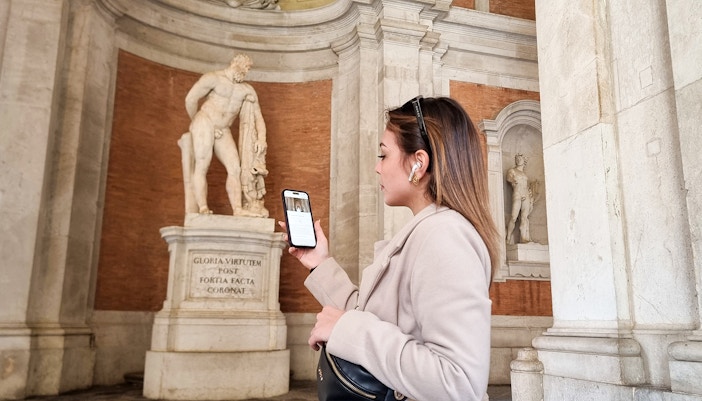
Yes, audio guides, available in Italian, English, French and Spanish, at the Royal Palace of Caserta cover the exciting details about the palace's interiors, architecture, artworks and history.
The Royal Apartments at Caserta is a window into the lives of the Bourbon royalty. King Charles of Bourbon's vision, meticulously realized by architect Luigi Vanvitelli, reflects both the grandeur and realities of royal life.
- Separate quarters for the King, Queen, princes, and princesses represent the emphasis on rank and hierarchy. Even within these quarters, separate rooms likely existed for sleeping, entertaining, and official duties, highlighting a structured and formal lifestyle.
- The grandiose State Apartments, designed for public functions, boast rich decorations, glittering chandeliers, and vast spaces. This reflects the Bourbons' desire to project an image of power, wealth, and absolute authority.
- Large windows and balconies, especially in private quarters, suggest a love of nature and a desire for light and fresh air, a unique feature that connects the apartments to the vast palace grounds.
- French-inspired design with symmetry, grand halls, and theatrical elements in the Palatine Chapel reflects the Bourbons' desire to rival other European monarchs.
- The palace's civil design, meant to blend with the city, reflects the Bourbons' progressive ideals of enlightened rule.
The Royal Palace of Caserta is known for its clever architectural tricks, like the hidden balcony above the Palatine Chapel. While there aren't confirmed "secret rooms," some speculate about hidden passageways within the palace walls.
The stories behind the palace's design and construction are fascinating. One such tale involves the colossal topaz planned for the Palatine Chapel altar. This enormous gemstone was never carved and remains a lost treasure.